
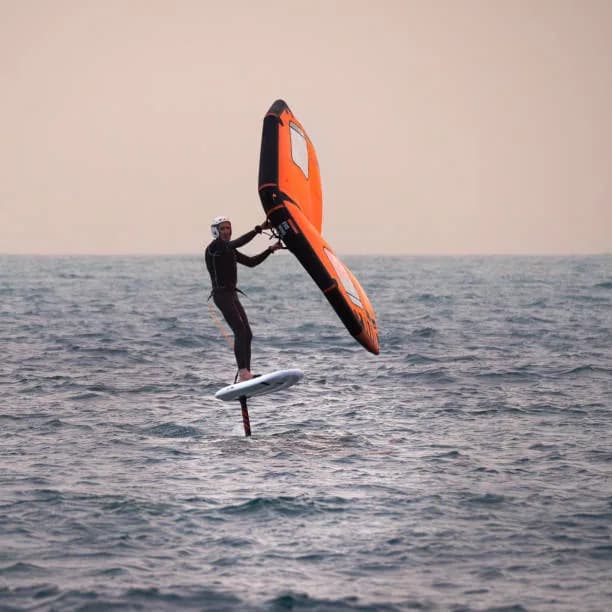
Wingfoiling is still young enough that a lot of visitors arrive in Essaouira having heard the name without quite knowing what it involves — understandably, since it borrows pieces from windsurfing, kitesurfing, and foiling all at once. This piece takes a different approach from a standard buyer's guide: it starts with what the sport actually is, works through why Essaouira's specific conditions happen to suit it unusually well, and compares it honestly against the other two watersports the town is known for, before getting into the practical details of a lesson.
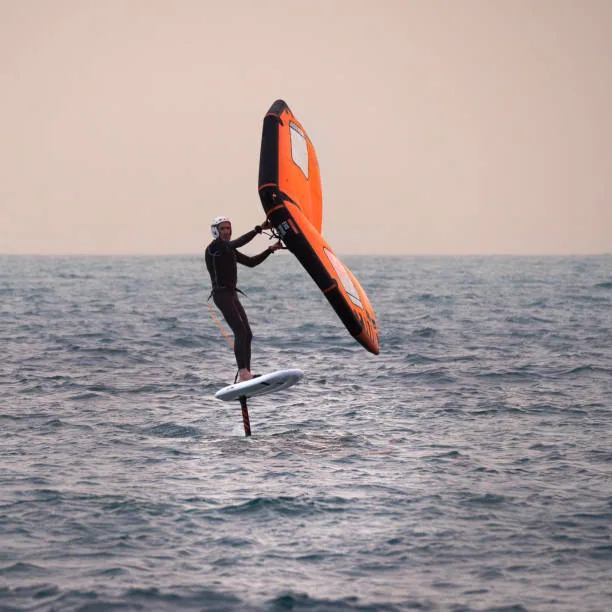
What Wingfoiling Actually Is, for Anyone Who Hasn't Tried It
A wing is an inflatable handheld sail — no lines, no harness connection, no bar. You hold it directly with two handles, and it generates power the way a small, freestanding sail would. Underneath, a hydrofoil board replaces a standard board's flat hull with a mast and wing-shaped foil that lifts the board out of the water once enough speed builds, so riders end up gliding just above the surface rather than pushing through it.
The result is a sport that feels distinct from both of its closer relatives: less equipment-dependent than kitesurfing (no lines to manage, no kite to relaunch from the water in quite the same way), but more physically dynamic than most windsurfing, since the foil's lift changes how the board handles compared to a flat hull sitting in the water.
Why Essaouira's Bay Happens to Suit Wingfoiling So Well
Consistent side-shore wind
The same alizé thermal wind that built Essaouira's kitesurf reputation works just as well for wingfoiling — a wing needs reliable wind to generate lift, and the bay's wind builds predictably through the afternoon on most days across a long season.
Flat, shallow inside sections
Because a wing has no lines connecting it to a bar or harness, riders have more freedom to walk out, adjust their grip, and reposition without untangling anything — and Essaouira's shallow, sandy inside water gives plenty of room to do this safely before heading further out.
No dangerous current
The bay's geography — sheltered somewhat by the small island of Mogador offshore — means the water lacks the strong, unpredictable current that makes learning foil sports genuinely risky at more exposed spots. This matters specifically for wingfoiling, where falls happen often during the learning phase and a rider needs calm water to recover in without being swept somewhere unintended.
Room to fall without hitting other riders
The width of the bay matters more for wingfoiling than it might for other sports, simply because the learning phase involves a lot of falling, re-launching the wing, and re-positioning the board — all of which take space, and Essaouira's long beach gives riders plenty of it even during busier sessions.
Wingfoiling vs. Kitesurfing vs. Windsurfing: An Honest Comparison
Visitors often ask which of Essaouira's three main watersports to try first, so it's worth comparing them directly rather than separately.
Learning curve: Windsurfing has the gentlest initial learning curve — most people can get moving, however imperfectly, within a first session. Wingfoiling's early stage (holding the wing, basic positioning) is also fairly approachable, but the foil itself adds a genuinely new skill — balancing on a board that lifts and behaves differently once it rises out of the water — that takes separate practice. Kitesurfing has the steepest early curve, since kite control alone takes real time before a board is even introduced.
Equipment complexity: Windsurfing gear (board, sail, mast, boom) is simple and self-contained — nothing needs to be "relaunched" from a difficult position the way a kite sometimes does. Wingfoiling is similarly simple in this respect, since the wing has no lines to manage. Kitesurfing carries more genuine safety-critical equipment (quick-release systems, self-rescue procedure) since a kite generates far more raw power at a distance from the rider.
Physical demand: Wingfoiling tends to load the arms and shoulders more directly, since you're holding the wing's handles continuously rather than relying on a harness (as in kitesurfing) or a boom your body weight partly counters (as in windsurfing). Sessions can feel more tiring in the arms specifically, even for otherwise fit riders, in the first few sessions.
What a first success feels like: A first short, wobbly glide on the foil in wingfoiling is a genuinely distinct feeling — different from a first wave in surfing or a first controlled ride in kitesurfing — and it's part of why the sport has built a dedicated following quickly despite being newer than the other two.
None of this makes one sport objectively "better" — it depends on what a visitor finds appealing, how much time they have, and whether they're drawn to the specific feeling of foiling above the water versus riding through it. Compare with our kitesurfing guide and surf lessons if you're still deciding.
What a Lesson Actually Involves
A first wingfoil lesson typically breaks down into stages, usually across more than one session for a genuinely new rider:
Wing handling on land or in shallow water. Before attempting to foil, students get comfortable holding the wing, feeling how it generates power as it's angled relative to the wind, and practicing depowering it — the wing equivalent of easing off the throttle.
Foil-free board time. Some schools start students on a flat board (or a foil board used without engaging the foil, kept at low speed) to build a feel for the wing's power and basic balance before adding the complexity of lift.
First foil attempts. Once wing control and basic board balance are solid, the instructor works on generating enough speed for the foil to lift, and — the harder part — staying balanced and in control once it does. This stage tends to involve a lot of falling, which is completely normal and expected rather than a sign of doing something wrong.
Riding and control. With repeated practice, students work on staying up longer, controlling height above the water (a foil that lifts too aggressively can be genuinely destabilizing), and eventually turning.
Because the foil-balance stage is the genuinely new skill compared to windsurfing or kitesurfing, most instructors recommend at least a few sessions — often structured as a multi-day short course rather than a single lesson — for a rider to get a real, repeatable feel for staying up on the foil. Book wingfoil lessons Essaouira or visit our wingfoil school.
A Day in the Life of a Wingfoil Session
To make this concrete: a typical wingfoil day at a well-run school in Essaouira might start with checking the forecast mid-morning, since the wing generally needs the alizé to have built to a usable strength — often early-to-mid afternoon rather than the early morning window preferred for surf lessons. Equipment gets matched to the day's wind (a larger wing on lighter wind days, smaller on stronger ones), and the group heads to a section of the bay with enough clear space for beginners to fall and reposition without crowding.
A typical session runs roughly two hours, split between wing-handling practice, foil attempts, and — for those who need it — a return to basics if a particular skill isn't clicking that day. Instructors generally adjust the plan in real time based on how a specific student is progressing, rather than running a fixed script regardless of what's actually working.
Safety Specifics Worth Understanding
Wingfoiling has different risk factors than kitesurfing or standard surfing, worth understanding before a first lesson:
- The foil itself has sharp edges. Unlike a flat board's smooth hull, a hydrofoil has genuinely sharp leading edges. Falls need to be practiced with this in mind — instructors typically teach a specific way of falling clear of the board and foil rather than simply tumbling however feels natural.
- Height control matters. A foil that lifts too high above the water can become unstable quickly, and part of early instruction focuses specifically on managing this rather than just generating speed.
- No leash-to-kite connection to rely on for control. Because the wing isn't tethered to lines the way a kite is, losing grip means the wing needs to be recovered separately from the board, which is part of why early practice happens in shallow, calm water rather than further out.
A school's safety briefing should cover these points specifically rather than a generic "watersports are exciting" framing — it's a genuine indicator of whether the instructor understands the sport's particular risks, not just watersports safety in general.
Equipment: What's Involved
A wingfoil rental setup typically includes:
- The wing itself — sized to the day's wind (commonly ranging from around 3m to 6m across most schools' rental fleets)
- A foil board — sized by rider weight and skill level, with volume mattering more for a beginner's stability during the early balance-building stage
- The foil assembly — mast, fuselage, and front/rear wings, sometimes swapped for a different foil size depending on conditions and rider progression
- A leash connecting rider to board
- A wetsuit, particularly relevant here since sessions often involve more time in the water during the learning phase than kitesurfing or surfing typically do
Confirm whether a full rental package (wing, board, foil, leash, wetsuit) is included in a lesson or course price, since some schools price the lesson and full equipment separately — a detail that changes the real cost comparison between operators significantly.
Best Time of Year and Time of Day
- Season: Similar to kitesurfing, the April–October window generally offers the most consistent wind strength for wingfoiling, though sessions happen across much of the year depending on conditions
- Time of day: Wind typically needs to build through the morning, meaning most wingfoil sessions run early-to-mid afternoon onward, similar to the kitesurf schedule rather than the earlier morning slots preferred for surf lessons
- Tide: Since much of early instruction happens in shallow water close to shore, checking the tide table alongside the wind forecast matters — a very low tide can expose sandbanks that change where a session is best run that day
Cost Considerations
Pricing for wingfoil instruction tends to sit in a similar range to kitesurf lessons, reflecting comparable equipment costs and instructor attention needed, though exact pricing varies by operator, group size, and package length. A single introductory lesson lets a visitor test whether the sport appeals before committing to a multi-day course aimed at reaching independent foiling ability. As with the other watersports covered on this site, confirm what's bundled into a quoted price — equipment, wetsuit, and instructor ratio all affect whether one operator's quote is genuinely comparable to another's.
Who Tends to Enjoy Wingfoiling Most
- Riders with some existing board-sport background (surfing, windsurfing, or kitesurfing) often pick up the foil-balance stage somewhat faster, though it's not a requirement
- Visitors drawn specifically to the feeling of foiling — gliding above rather than through the water — which is genuinely different from the sensation either surfing or kitesurfing offers
- Travelers wanting a session that doesn't require the multi-day kite-control buildup kitesurfing typically needs before a first board attempt, since wing handling itself is comparatively quick to pick up
Final Thought
Essaouira didn't build its reputation around wingfoiling the way it did around kitesurfing, simply because the sport is newer — but the same underlying conditions that made the bay a serious kite destination (reliable side-shore wind, sandy shallow water, room to fall safely) turn out to suit wingfoiling just as naturally. For a visitor deciding between the bay's three main watersports, wingfoiling sits in an interesting middle ground: simpler equipment and quicker basic handling than kitesurfing, but a genuinely new balance skill — staying up on the foil — that windsurfing doesn't ask of a rider. Worth trying specifically for that distinct feeling, rather than as a simple substitute for either of the other two.